Cellini JR. and Sr. Cello Stool
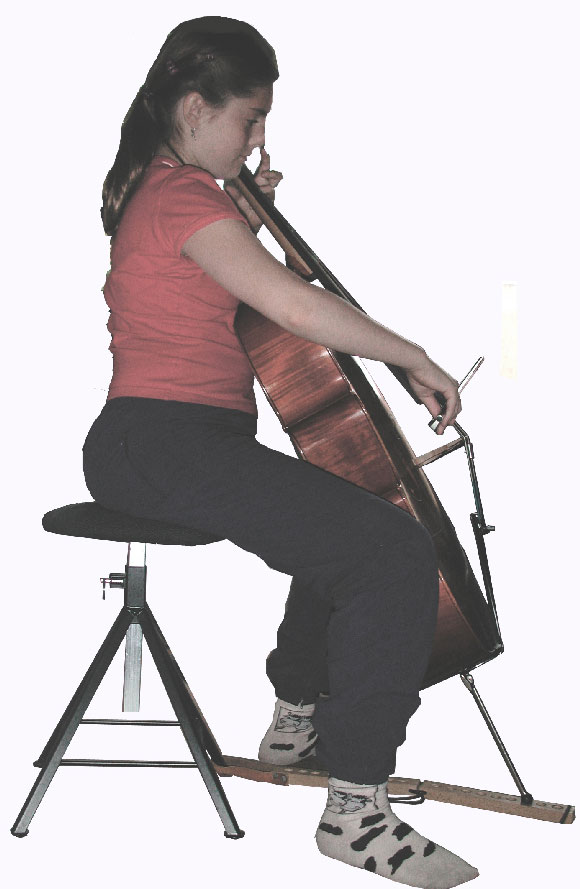


Playing a bowed string instrument takes a lot of practice. An early start is therefor recommended. The Suzuki method even starts to train children from 3 year of age. Motivation lies in playing melodies right from the start. According to Shinichi Suzuki, the man who developed the Suzuki Method, one can learn the language of music in a similar way as the language of speech. This means that practice at home and at the music school should have the same caring environment.
The cello is played while seated. Finding a seat with the right height for a growing child is difficult. Justifying an existing seat only temporary fits the required seating height. A seat that meets the ergonomic needs will motivate children to be seated for a longer period. An adjustable seat is then an adequate solution. Adjustable seats however, turn too easily or have too many tolerances that could hamper stable seating and furthermore you would like, as a child, to adjust the chair too high to look older.
Lots of parents and cello teachers face this problem. A special designed adjustable cello stool could meet also the other requirements of cellists. Understanding the posture of a cellist and why standard seats fail is then required for designing such a seat. Most chairs have a seat back angle in order to keep the knees straight while leaning backwards. A cellist however, balances without a backrest on his knees that have a slightly larger angle, keeping his feet straight on the floor. The choice for an adjustable stool without a seat back angle is therefor indisputable.
The weight of a cello is supported mainly by its endpin, which rests on the floor. The cellist however has to seize the cello between the knees and upper chest for steadying the forces of the bow on the strings and cello positions on the neck. Most seats don’t match the width of the spread legs and lack proper support. Therefor the cello stool seat has a wider front than back. The seat is not too soft for more freedom of movements and has luxury leather upholstery for durability.
A height adjustment mechanism with intervals of 2.5 cm would be adequate. The benefit of these distinctive intervals is that the teacher can fix the position for each scholar and communicate changes in the position with the parents for the position of the stool’s seat at home. It is not advisable that children could change this position themselves. The adjustment mechanism has a child safety and should be operated with more strength at the beginning. Afterward the interval positions will be chosen automatically. The square straight adjustment provides the cellist with a steady seat without rotation and minimal tolerances.
The endpin of a cello needs to be placed in a stopper preventing the pin to slide away on smooth floors. The hoop of the strap should be anchored to the leg of the cellist's stool. Cellist’s stools should have legs for this reason. A stool with 3 legs is stable. Moving out the triangular base however will make the seat wobbly. A stool with 4 legs can have more stability with a limited floor area. This is also convenient for transforming the stool to a compact package during traveling to concerts or workshops. Just taking the seat out and putting it in at the opposite side will do the job.
The Bolan-Cordia Cello Stool has been designed by Anneloes Cordia and has been distributed from 1998 to 2009 via the Suzuki Cello Group Benelux to many music schools, teachers and scholars. The experiences of teachers and scholars were so positive that after lots of requests from the market it is decided in 2011 to produce this stool on a larger scale. Not only children are able to practice for longer periods using this stool but also adults have experienced the benefits. The Junior has a seat height of 28 to 45 cm. A child can use this stool till he is full-grown. The Senior has a seat height of 40 to 57 cm and is especially designed for (young) adults with a robust frame for more severe utilization.
For sales and distribution, please contact: